

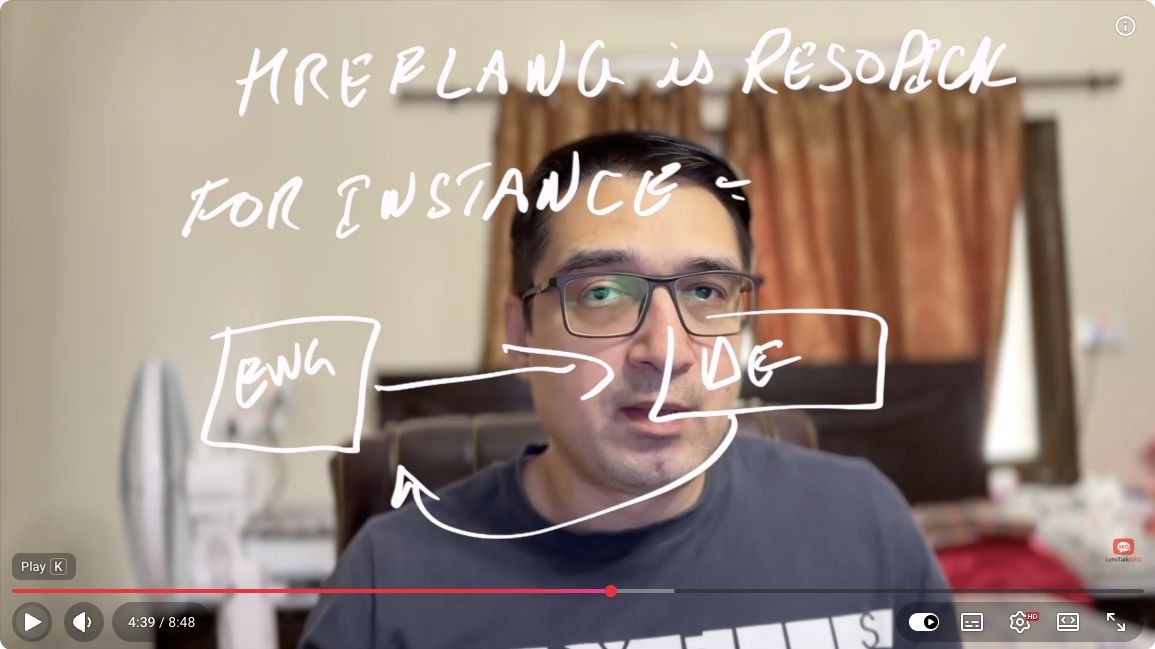
Your English page lists an Arabic alternative. The Arabic page never points back. A plugin has produced tags, but the relationship between the pages is incomplete.
Hreflang helps describe corresponding language or regional versions of a page. Check valid codes, reciprocal annotations, the correct destination URLs and alignment with your intended canonicals. It helps Google understand alternatives; it does not translate content or guarantee rankings.
My original video focuses on missing return links and incorrect region codes. This guide adds a worked English–Arabic example and a practical verification process for a multilingual business website.
Map equivalent pages before touching the tags
List each page purpose and its real alternatives. An English consulting page belongs with its Arabic consulting equivalent, not automatically with the Arabic home page.
| Page purpose | English version | Arabic version | Decision |
|---|---|---|---|
| SEO consulting | /en/consulting/ |
/ar/consulting/ |
Corresponding alternatives |
| Contact information | /en/contact/ |
/ar/contact/ |
Corresponding alternatives |
| English-only tutorial | /en/tutorial/ |
No equivalent | Do not invent an Arabic match |
These addresses are illustrative. Use the actual public URLs on your site and check that the content serves the audience described. Tagging an English page as Arabic does not make it an Arabic resource.
Also decide whether region targeting is genuinely needed. Language-only en and ar may suit a broad audience; en-AE and ar-AE describe versions specifically for the UAE. The code should reflect the real version, not a keyword target pasted into every page.
Make the annotations reciprocal
If English lists Arabic, Arabic should list English. Include each page’s own language version too. The simplest maintenance model is a consistent set of corresponding alternates on both pages.
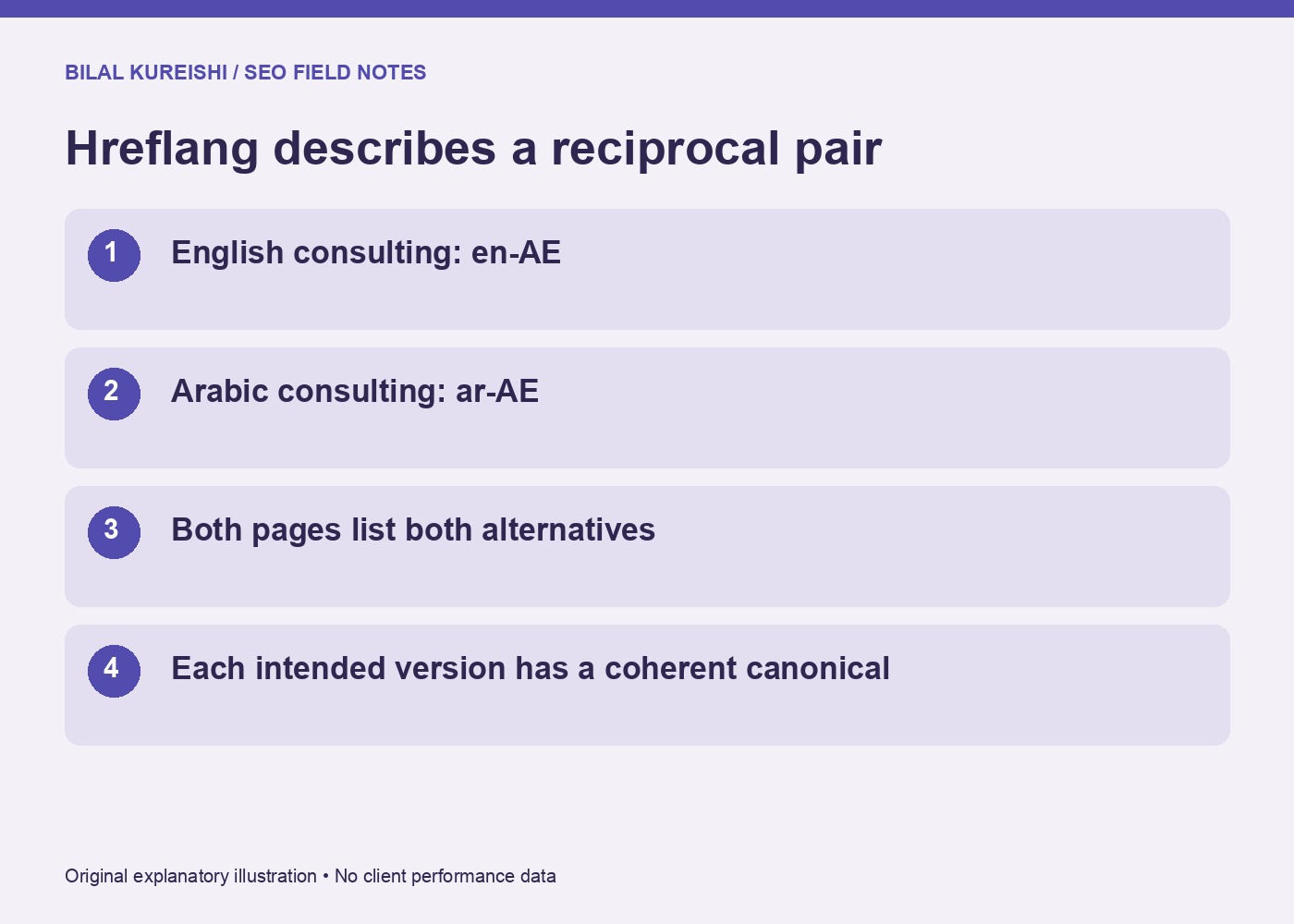
Here is an illustrative HTML set for a pair specifically targeting UAE English and Arabic. Place the same alternate set in the head of both corresponding pages:
<link rel="alternate" hreflang="en-AE"
      href="https://example.com/en/consulting/">
<link rel="alternate" hreflang="ar-AE"
      href="https://example.com/ar/consulting/">
The English page can have its own English canonical, and the Arabic page its own Arabic canonical, where these are the intended distinct versions. Do not routinely canonicalise every translation to English while also asking Google to treat the translations as language alternatives.
Google’s localized-version documentation explains reciprocal annotations, self references and supported implementations. Choose an implementation your team can maintain consistently.
Use language first, then an optional region
The first part identifies a supported language. An optional second part identifies a supported region. A country code by itself does not identify a language.
| Example | Interpretation |
|---|---|
en |
English, without a specific regional qualifier |
ar |
Arabic, without a specific regional qualifier |
en-AE |
English for the United Arab Emirates |
ar-AE |
Arabic for the United Arab Emirates |
en-GB |
English for Great Britain |
UK |
Not a valid language-and-region specification |
Keep the codes in your page mapping sheet, then compare the actual output with the plan. A spelling error in one template can affect many relationships, so inspect more than the home page.
Choose a fallback deliberately
x-default identifies a fallback for language settings that do not match the specified alternatives. A language selector can be a sensible destination when the site has one. Another suitable page may be appropriate for the intended experience.
<link rel="alternate" hreflang="x-default"
      href="https://example.com/language-selector/">
This is an optional illustrative addition, not a reason to invent a selector URL that does not exist. Its absence does not mean your pages cannot appear in search outside their specified regions.
Check how the fallback behaves. A selector that redirects everyone into an unexpected language or fails on mobile undermines the visitor’s choice, regardless of how tidy its tag looks.
Audit the output, not the plugin checkbox
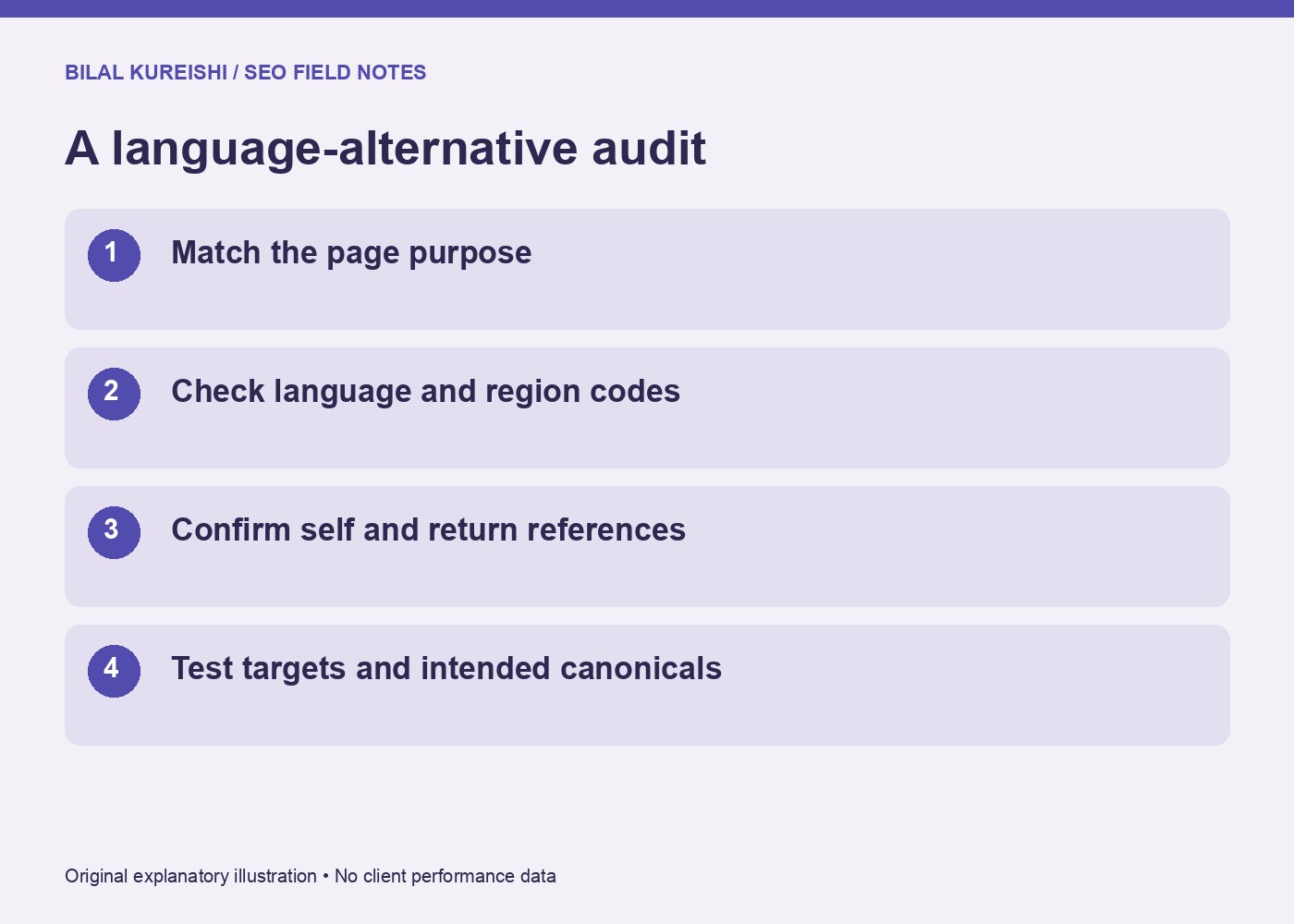
Whether tags come from a translation plugin, template or sitemap, inspect the implemented result. A setting labelled “enabled” establishes less than a working relationship between the real pages.
- Open the English page and its corresponding Arabic page.
- Check the actual alternate URLs and language codes in the chosen implementation.
- Confirm self references and return annotations.
- Follow each target and check that it resolves to the intended public page.
- Compare the canonical with the intended language version.
- Check the mapping across another template, such as a service, article and contact page.
- Repeat after changes to translations, URL slugs or plugins.
If a translated URL moves, update its references in every related version. Fix internal language-switcher links too; they are visitor navigation, while hreflang supplies search annotations.
For a broader route review, my website-architecture guide helps connect page purpose with navigation. Record the mapping and checks as part of the work described in a useful SEO audit.
Does hreflang fix duplicate-content problems by itself?
It describes alternatives. It does not replace a clear canonical strategy or make unnecessary copies useful. Assess equivalent regional content and translation quality alongside the tags.
Does it control which language every visitor sees?
It is a search signal, not a substitute for an accessible language switcher. Let visitors choose and test that route on a phone.
Start with one language pair and verify it end to end before rolling out a site-wide change. If the relationships span many templates, discuss an international SEO review.
Watch the original video
This guide adapts my original Let’s Talk SEO tutorial. Historical examples are distinguished from current documentation; no example above promises search results.