

Your rankings are improving. The traffic report looks healthy. Yet the enquiry inbox is quiet. Before chasing another keyword, look at the page your potential customer actually lands on.
SEO rankings do not automatically generate leads. Visibility, clicks and enquiries are separate stages. A page can attract the wrong audience, bury its offer or make contacting you unnecessarily difficult.
In my Let’s Talk SEO video, I focus on the moment after the click: does your copy make visitors feel they have found the right business? This guide turns that principle into a practical service-page review.
Find where the journey breaks
Start with one commercially important landing page. Define a qualified lead before opening a dashboard: for example, an enquiry from someone in your service area who needs a service you actually provide. Counting every form submission can hide a targeting problem.
Then compare search visibility with visits and outcomes. Google Search Console helps you understand queries and clicks; your analytics and enquiry records help explain what happens on the website. Neither source alone gives you the full customer journey.
| What you observe | What to investigate first |
|---|---|
| Few relevant impressions | Targeting, demand, indexability and page purpose |
| Impressions but few clicks | Query mix, average position and search-result presentation |
| Visits but few enquiries | Offer clarity, trust, mobile usability and form delivery |
| Enquiries but poor fit | Audience targeting, qualification and stated service scope |
If tracking has not been tested, do that first. Submit a real test enquiry, confirm that it reaches the inbox and check that the intended conversion event appears. A broken form or missing event can make a functioning page look ineffective.
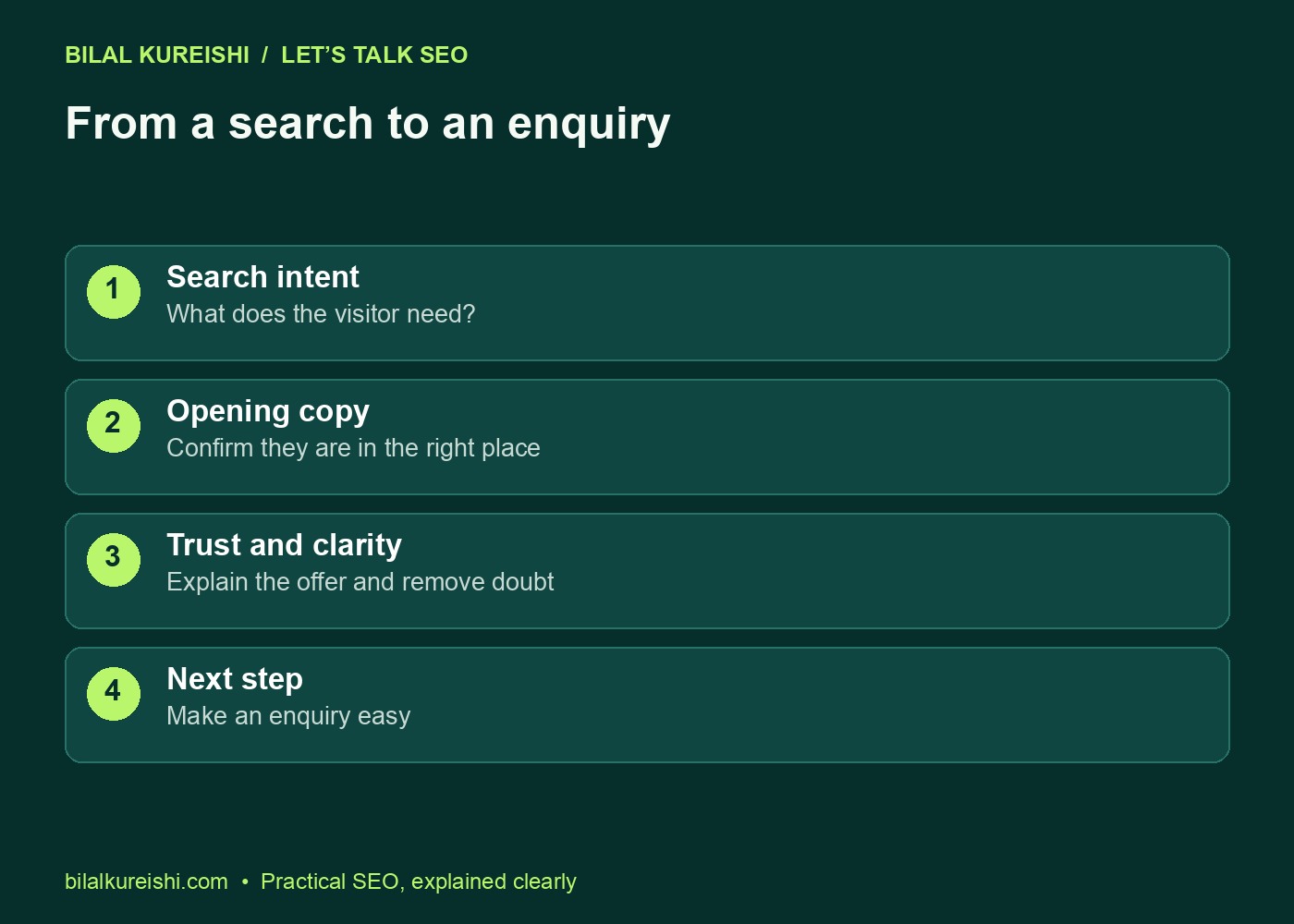
Match the opening to the searcher’s intent
Read the queries bringing people to the page. Are they learning, comparing providers or trying to book? Someone asking what SEO means needs an explanation. Someone searching for an SEO consultant in Dubai needs to understand your scope, fit and next step.
The same applies to the plumbing example in my video. A person searching for a slow-draining sink wants practical information. A person looking for an emergency plumber needs availability and reassurance. A dictionary definition delays the answer in the second situation.
Write down the visitor’s immediate question in plain language: “Can you solve this problem for a business like mine?” Put the answer before your company history. Include a location only when it genuinely affects availability or service delivery.
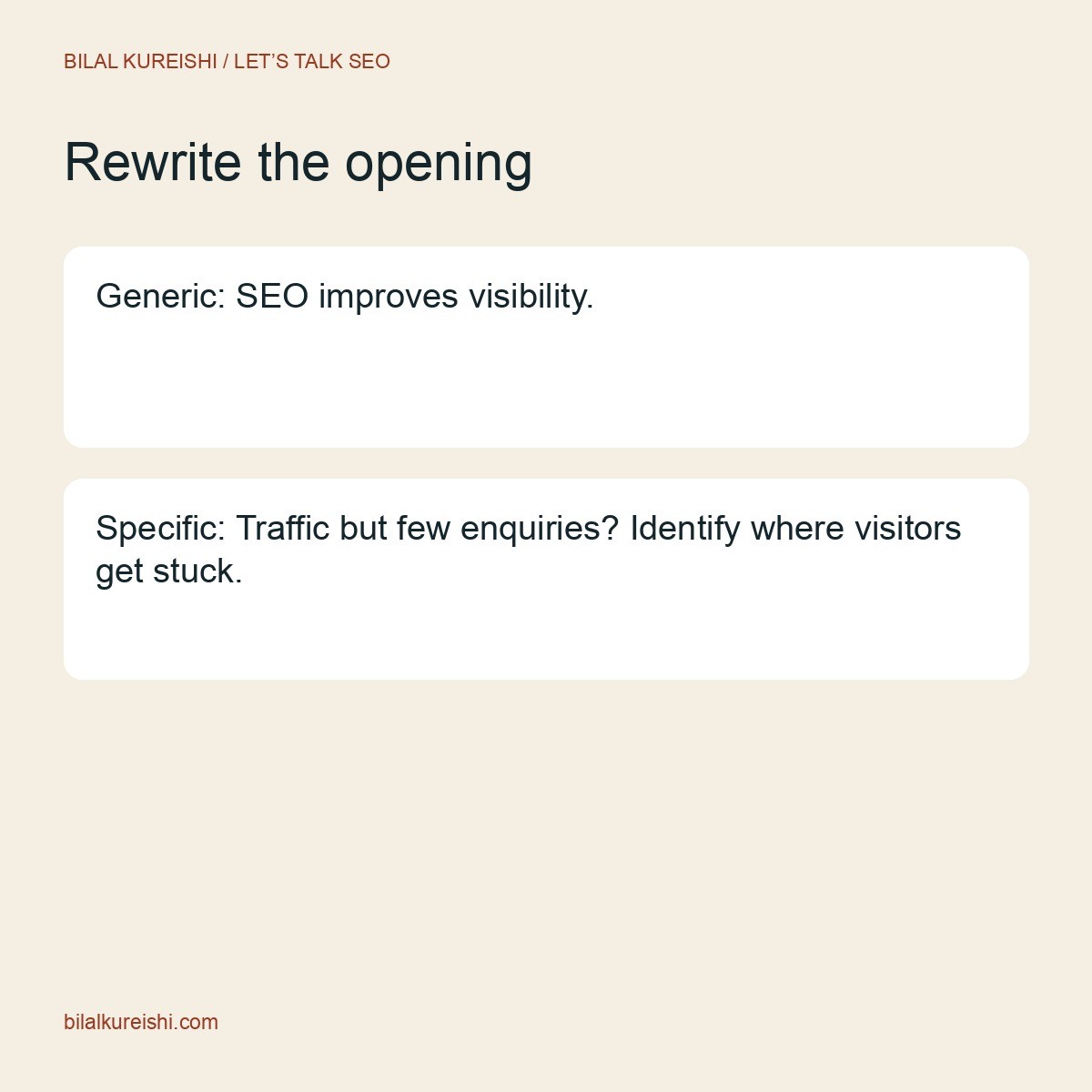
A before-and-after service-page opening
| Generic opening | More useful opening |
|---|---|
| “SEO improves website visibility. Every business needs SEO.” | “Getting search traffic but few enquiries? My SEO consulting helps Dubai businesses identify technical issues, content gaps and weak commercial pages, then prioritise the next steps.” |
The second opening identifies the audience, problem and work involved. It is an illustrative rewrite, not a claim of a measured conversion increase. Your actual page must accurately describe what you deliver.
Replace vague reassurance with useful evidence
Once a visitor understands the offer, the next question is whether they should trust it. “Results-driven” and “industry-leading” give them little to evaluate. Specific information about the engagement is more useful.
- Scope: What will you review or deliver, and what falls outside the engagement?
- Responsibility: Who does the work, and who implements the recommendations?
- Process: What access or information is needed to begin?
- Evidence: Are there relevant examples or genuine testimonials you have permission to publish?
- Expectations: How will priorities and progress be discussed?
Place evidence near the claim it supports. A testimonial about communication belongs near the explanation of how you work. A technical example should explain the original problem and the intervention. Avoid presenting an unrelated success as proof that every new client will get the same result.
For an independent assessment, my guide to what an SEO audit should tell a business owner explains how to connect recommendations with business priorities rather than tool scores.
Make the next step easy on a phone
A useful offer can still lose enquiries when the contact route is unclear. Use a button label that describes the action, such as “Discuss your SEO priorities”. Explain what happens after submission without promising a response time you cannot meet.
Ask for enough information to route the enquiry, not a full discovery workshop in the first form. For a consultancy, a name, contact address, website and short description of the problem may be a sensible starting point.
- Open the landing page on a phone and read only the first screen.
- Check whether the service and intended customer are immediately clear.
- Follow the main contact route with your thumb.
- Complete the form, including validation and confirmation messages.
- Confirm delivery and tracking, then remove the test enquiry from reporting.
Check practical friction: text hidden behind a sticky header, a call-to-action obscured by a cookie panel, unreadable labels or a form that forces horizontal scrolling. These are concrete reasons to investigate conversion loss.
Measure qualified leads, then iterate
Keep a baseline for the page and note the date of each meaningful edit. Record organic landing sessions, completed enquiries and qualified enquiries separately. If you calculate a conversion rate, state the numerator and denominator so everyone is comparing the same measure.
For example, qualified enquiries divided by organic landing sessions describes one part of the journey. Search Console clicks and analytics sessions are different measurements; do not expect them to match perfectly or mix them casually in a single rate.
Change a specific weakness first. If the opening is vague, improve it and the nearby explanation. If the form is broken, fix it before rewriting the entire page. Review a period with enough relevant visits and account for seasonality, campaign changes and traffic mix.
Questions business owners ask
Should I stop SEO if rankings are not generating leads?
First identify the failure point. Weak targeting, low click volume, an unclear offer and broken enquiry tracking need different responses. Stopping a channel before diagnosing it can discard useful demand.
Will adding more keywords improve conversions?
Repeating phrases does not answer the visitor’s decision questions. Use relevant language naturally, then explain fit, evidence and the next step. The aim is a useful landing page for the query you are targeting.
Start with one page that matters to the business. If you need help separating visibility problems from conversion problems, explore my SEO consulting and send me the page you want reviewed.
Watch the original tutorial
This guide develops the practical ideas in my original Let’s Talk SEO video. The examples and checklists above are editorial illustrations, not client performance results.