
“Click here” tells you there is a link. It does not tell you whether the next page is a pricing guide, a contact form or a downloadable checklist. On a busy page, that small ambiguity repeats quickly.
Good anchor text describes a relevant destination in concise, natural language. Fix generic wording, mismatched promises, keyword-heavy phrases and cluttered passages. Read the destination before choosing the words.
My video discusses five recurring anchor-text problems. This updated workflow keeps the practical editing advice without turning historical examples into fixed percentages or ranking guarantees.
Replace vague wording with a clear destination
Start with prominent links people use to make decisions. Read only the clickable text, then ask whether it gives a reasonable idea of what comes next. Review the surrounding sentence too: context still matters.
| Weak wording | Better wording | Why it helps |
|---|---|---|
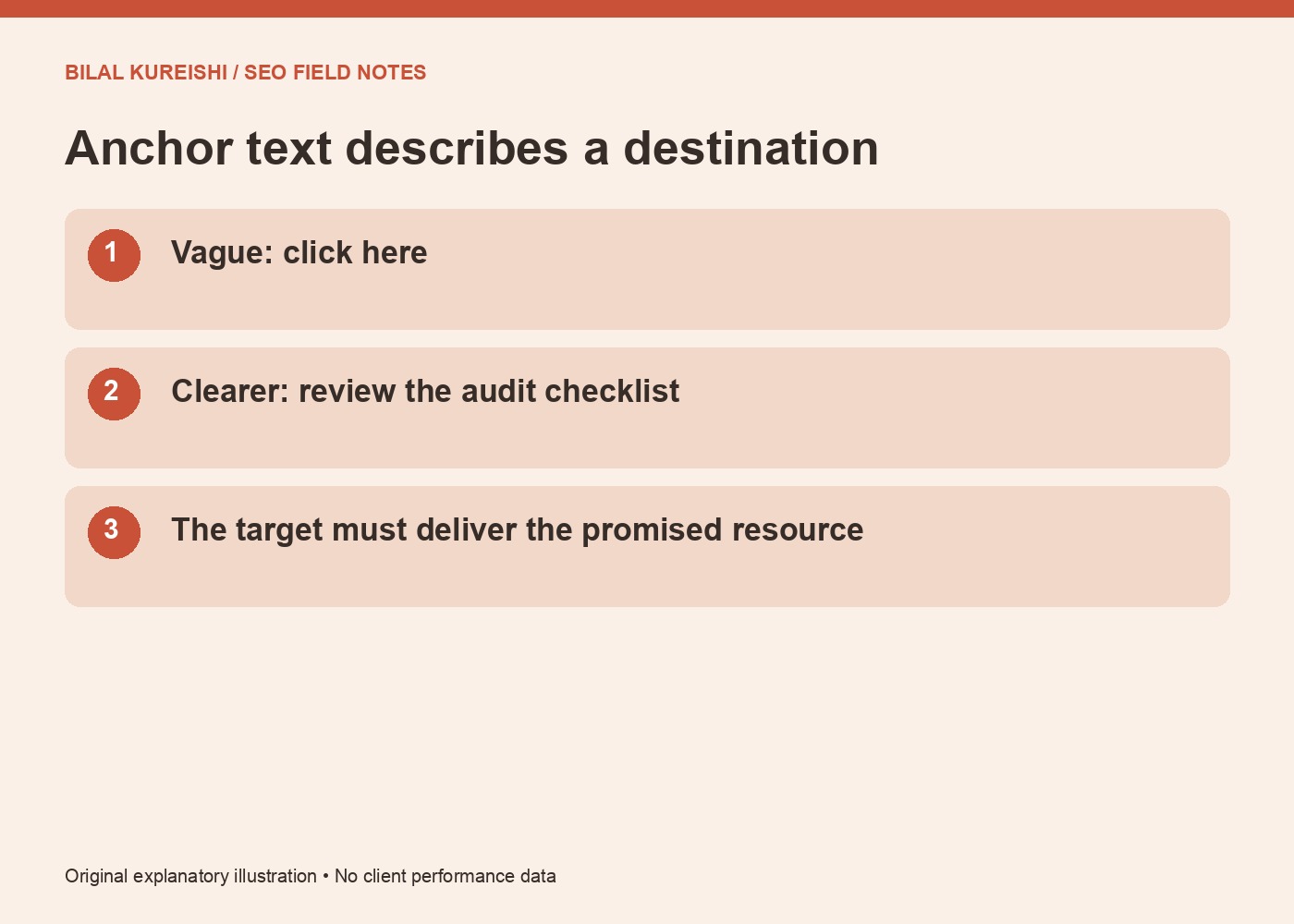
| Click here | Review the SEO audit checklist | Describes the resource |
| Download | Download the content-review worksheet | Names the file and task |
| Learn more | Compare the consulting engagement options | Explains the decision |
| Get it here | View the implementation guide | Identifies the destination |
These are illustrative rewrites. Use the real title or purpose of the destination; do not promise a worksheet or engagement option that does not exist.
Stop making the link promise the wrong thing
A relevant keyword does not rescue an inaccurate link. An anchor about “SEO pricing” should not land on a generic home page that contains no pricing explanation.
Imagine a sentence reading: “Check the technical audit scope before commissioning the work.” A link on “technical audit scope” belongs on a page explaining that scope. If the destination only offers a contact form, either change the destination or explain that the next step is to request a scope discussion.
When reviewing, write down the promise made by the anchor and the answer delivered by the page. A mismatch gives you a concrete editing task rather than a vague “optimise links” instruction.
For the broader process, read my internal-linking workflow. It covers page selection and placement, while this guide focuses on the clickable wording and immediate context.
Use relevant language without stuffing every phrase
An anchor such as “best SEO expert consultant SEO services Dubai” interrupts the sentence and obscures the actual destination. “SEO consulting” can say what the reader needs more clearly.
Do not respond by building a spreadsheet of compulsory exact-match percentages. Different sites and passages use different natural wording. There is no universal requirement to keep precisely two phrases or hit a fixed anchor ratio.
Google’s link guidance recommends descriptive, concise and relevant wording, with useful surrounding context. Apply that test directly to the passage.
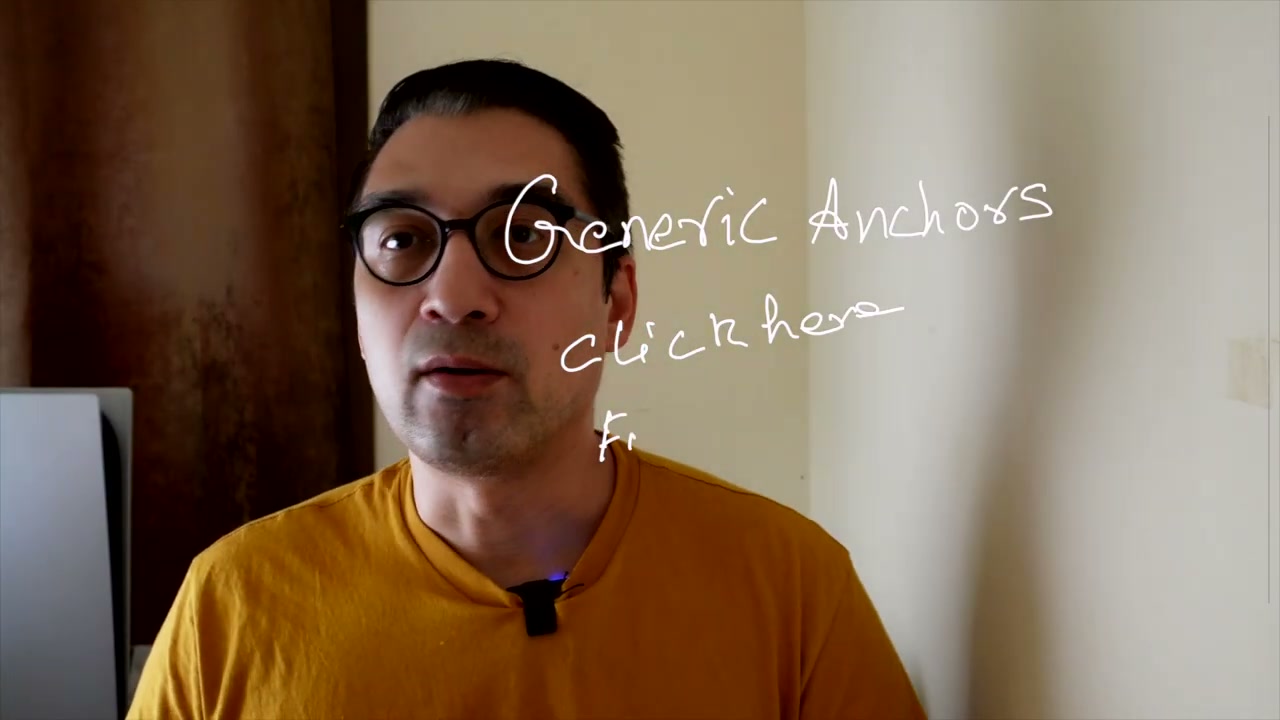
The source frame introduces the generic-anchor problem. The article’s examples are editorial rewrites, not evidence of a measured ranking increase or a client recovery.
Vary language only when the meaning stays accurate
Two different anchors can point to the same page without creating confusion. “Content refresh framework” and “decide whether to update an article” can both accurately describe a resource about updating existing content.
The problem starts when the variation promises different subjects the destination does not cover. “Football rules”, “football boots” and “football coaching prices” are different needs; pointing them all at one vague page does not make the page answer all three.
| Review question | Useful evidence |
|---|---|
| Does the wording fit this sentence? | Read the full paragraph aloud |
| Does the target deliver the promise? | Read the destination itself |
| Is the phrase unnecessarily long? | Remove words that add no meaning |
| Is the link a useful next step? | State the reader’s question it answers |
Reduce clutter and test the interaction
A paragraph with six adjacent links gives readers little context for each choice. Give a useful resource a clear place in the explanation, and remove links that have no specific job.
On a product card, an action such as “Add to cart” may be appropriate because the product and interaction provide the context. Do not make every button an awkward keyword phrase in the name of SEO.
Check keyboard focus, visible link styling and tap behaviour on a phone. Confirm that downloads are labelled accurately and that an important route is not hidden behind a sticky element or promotional banner.
Better usability can help people complete tasks. That does not establish that a higher ecommerce conversion rate directly causes higher Google rankings. Measure user outcomes on their own terms.
Run a focused anchor-text review
Choose one important destination, then review the pages linking to it. A crawl or site inventory can help locate candidates, but the editing decision requires reading the context.
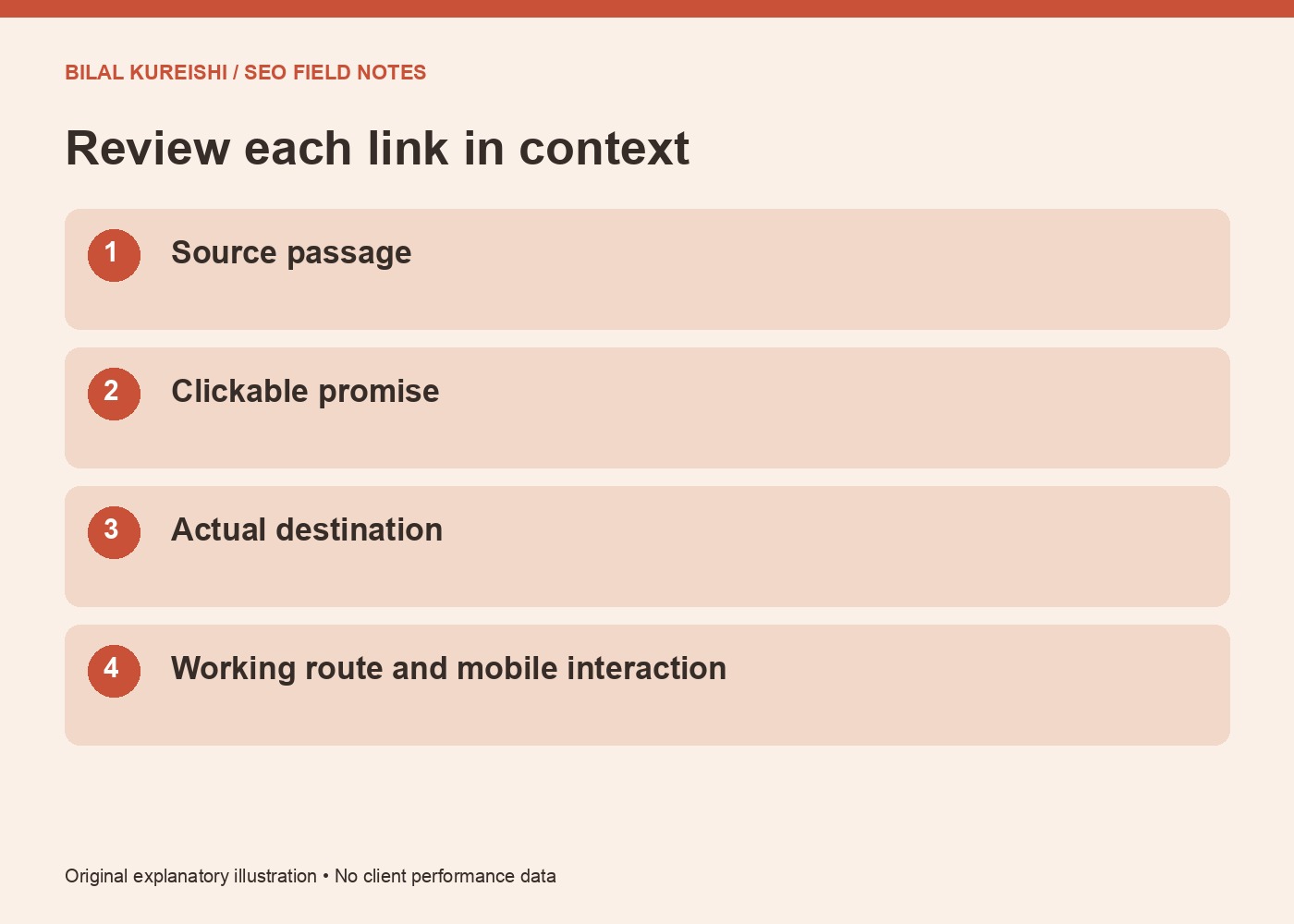
- Record the source URL, anchor and target.
- Open the target and summarise its actual purpose.
- Identify vague, inaccurate or overloaded wording.
- Rewrite the anchor and surrounding sentence together.
- Test the route, including redirects and any file download.
- Preview the passage on desktop and mobile.
- Keep a short change log so future page moves do not leave misleading links.
If the target itself needs improvement, use the update-or-new-content framework first. Rewording a link cannot repair a destination that fails to answer the question.
Must every “read more” link be removed?
Consider the full interface and accessible label. In a clearly labelled card it may have sufficient context; in a standalone paragraph a descriptive resource name often works better.
Will anchor-text edits immediately increase rankings?
No guaranteed outcome follows from a wording change. Review whether the routes become clearer and whether people can use the intended resource.
Try the out-of-context test on your five most important links. For a wider content and navigation review, explore my SEO consulting.
Watch the original video
This guide adapts my original Let’s Talk SEO tutorial. Historical examples are distinguished from current documentation; no example above promises search results.